
In short
Missing utility connections do not rule out a mortgage, but the bank asks how the house will get power and water and where the sewage goes. In a construction loan, connections are a normal cost item and one of the stages the bank checks before the next tranche. The hardest moment is the end of construction: the completion notice needs test reports for the connections, and banks want that document within a set time after the last tranche. A septic tank, a household treatment plant or a well are allowed if they are in the design and notified.
Plot without utilities: what the bank checks
The bank starts with the legal basis for building. Where there is no local zoning plan, a decision on development conditions (warunki zabudowy, WZ) is needed, and the municipality issues it only if existing or planned utilities are sufficient for the house (art. 61(1)(3) of the spatial planning act). No network in the street is not the end, but someone has to show where the house will get its utilities.
The simplest proof is connection conditions (warunki przyłączenia) from the network operators: the power distributor, the water company and, if available, the gas network. According to the Polish home building magazine Murator (June 2026), water and sewer conditions are issued within 14 days and valid for two years, electricity conditions usually within 30 days of a complete application. Ask for them before the preliminary agreement, so you know how far the network is and what the connection costs.
Septic tank, treatment plant or well instead of a network
Where there is no sewer, the law allows a sealed septic tank (szambo) or a household treatment plant. The act on cleanliness in municipalities (art. 5(1)(2)) requires connection to an existing sewer and allows a tank or treatment plant where building a sewer is technically or economically unjustified. If a sewer already runs in the street, the municipality can require you to connect. Under the Building Law (art. 29(1) points 5, 6 and 23), a septic tank up to 10 m³ and a treatment plant up to 7.5 m³ a day need a notification, and utility connections need no building permit but require a site plan on the official map. For the bank, what matters is that the solution is in the design and in the cost estimate.
| Solution | Formality | What you show the bank |
|---|---|---|
| Power, water, sewage or gas connection | no permit, site plan | connection terms and agreement |
| Septic tank up to 10 m³ | notification at the county office | design, notification without objection |
| Treatment plant up to 7.5 m³ a day | notification at the county office | design, notification without objection |
| Own well | depends on depth and abstraction | plot development plan |
Building Law art. 29(1)(5), (6) and (23) and art. 29a, as of 1.11.2026. Details
Connections need a site plan on the base map, unless you notify them together with the house.
Utility connections and construction tranches
In a construction loan, connections are a normal cost item, usually in the first stage with the foundations or with the installations. The bank releases the next tranche only when the stage paid by the previous one is done. BOŚ Bank inspects before every tranche and can stop further tranches if the work does not match the design; Bank BPS has a mandatory inspection before the second and the last tranche. Water and sewer connections are built at the investor’s cost, which Murator puts at up to 500 zł per metre. Temporary site power is not the house connection, which must be ready before completion.
End of construction
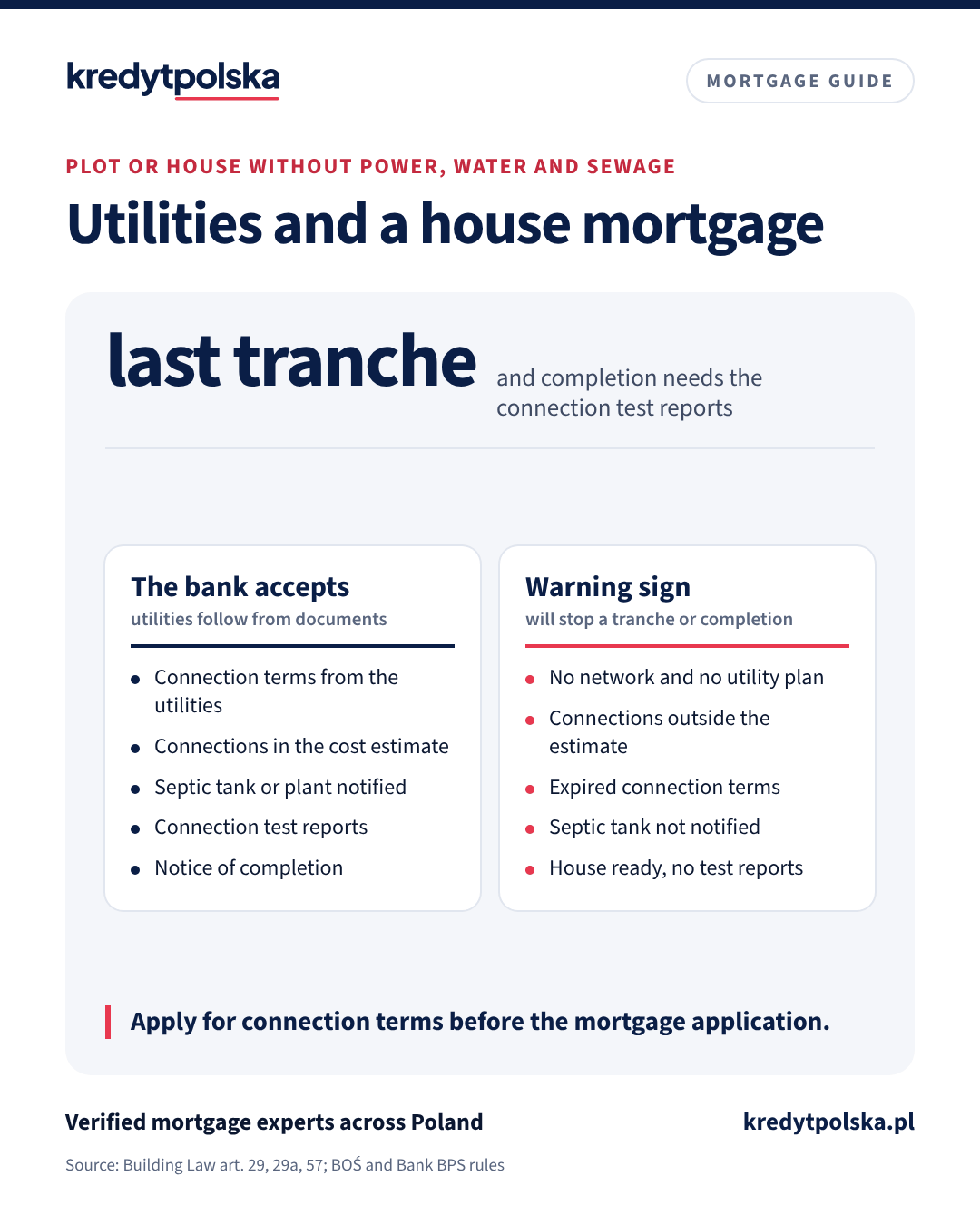
The completion notice (zawiadomienie o zakończeniu budowy) or the application for an occupancy permit must include test reports for connections and installations and confirmation that the connections were accepted (Building Law art. 57(1) points 4(a) and 6). BOŚ Bank’s rules require the occupancy permit or completion notice within 4 months after settling the last tranche, otherwise the margin can go up. Order the connections at the start of construction, not at the finishing stage.
Buying a house with only some utilities
Older rural houses often have a septic tank, a well or power through a neighbour’s installation. Check that the house has its own electricity connection and supply contract, whether cables or pipes cross other plots without any legal right, whether the septic tank was notified, and whether the house has a completion notice or occupancy permit. An easement for a utility supplier is normal; BOŚ Bank accepts it explicitly.
The full description in Polish, with a checklist before the deposit: Dom bez przyłączy a kredyt.
Frequently asked questions
Can I get a mortgage on a plot without power and water in Poland?
Often yes, if the plot has a zoning plan or WZ decision and utilities can be brought in. Connection conditions from network operators help. Deposit and valuation rules differ between banks.
Will a bank accept a septic tank instead of a sewer?
Polish law allows a septic tank or treatment plant where a sewer is technically or economically unjustified. The bank checks that it is in the design and notified.
Can I finish construction without utility connections?
Formally hard. The completion notice needs test reports for connections and installations, and the bank wants that document within a set time after the last tranche.
Sources
- Building Law, art. 29, 29a and 57, Journal of Laws 2026 item 524 (Polish)
- Act on spatial planning, art. 61 (Polish)
- Act on cleanliness and order in municipalities, art. 5 (Polish)
- BOŚ Bank: mortgage rules from 17 April 2026 (Polish)
- Bank BPS: mortgage rules from 13 February 2026 (Polish)
This guide describes general rules and typical bank practice as of October 2026. Details
It is not legal or tax advice and not a bank offer. Each bank sets its own criteria, and the lending decision is always made by the bank.
Read next
Mortgage calculator for Poland: your monthly instalment
Mortgage calculator for foreigners buying in Poland: equal or decreasing instalments in złoty, total interest, LTV, the bank stress test and a year-by-year schedule.
Buying a house in Poland without a completion notice or with unauthorised construction: will a bank lend?
How Polish banks treat a house that is lived in without a construction completion notice, or that has an unauthorised extension (samowola budowlana): how to finish the formalities, legalisation after 20 years, penalties and what to check before buying.
Barn conversion mortgage in Poland: can you turn a barn or farm building into a house with a bank loan?
Can you get a Polish mortgage to convert a barn or farm building into a house? Change of use notification, local plan or zoning decision, technical assessment, valuation after works and tranches.
Buying an unfinished house from another person in Poland with a mortgage
How to buy a house under construction (stan surowy) from a private seller in Poland with a mortgage: tranches, valuation, transfer of the building permit, a build stopped for years and the seller’s loan.
House extension mortgage in Poland: notification or permit, and what the bank needs
A Polish mortgage for extending a house or adding a storey: when a notification is enough and when you need a building permit, which documents the bank wants, and how tranches and the valuation after the works work.
Buying a house or plot in Poland: access road, road share and the mortgage
Why a Polish bank checks legal access to a public road before a mortgage on a house or plot, how a share in a private access road and a road easement work, and what to check before paying a deposit.
Mortgage for a rural homestead in Poland: buying a house with farmland
Can you buy a Polish siedlisko, a country house with farmland, with a mortgage? Why banks prefer a separate homestead plot, who may buy farmland (0.3 ha and 1 ha thresholds, KOWR) and how to build a house on a homestead.