
In short
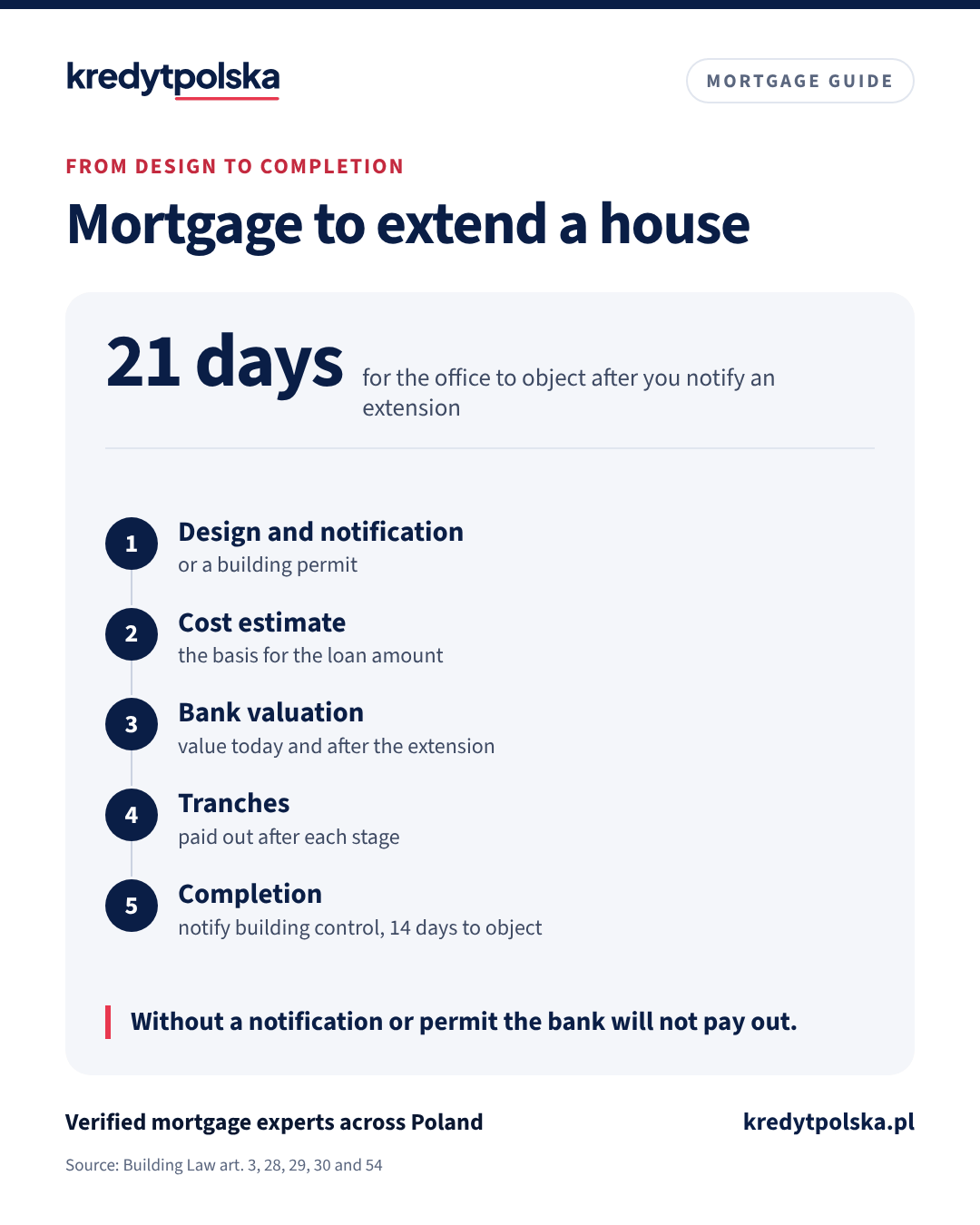
Under Polish building law an extension (rozbudowa) or an added storey (nadbudowa) counts as construction, so you need a building permit or a notification, as for a new house. For a detached single-family house whose area of impact lies entirely on your plot, a notification is enough, and you can start if the office does not object within 21 days. Banks finance this with a construction mortgage: they want the notification without objection or the permit, a cost estimate and a valuation of the house today and after the works, and they pay out in tranches. If the works do not change the shape of the house, it is a rebuilding or renovation and a simpler loan will do.
Extension, rebuilding or renovation
This decides the formalities and the type of loan. The Polish Building Law treats an extension and an added storey as construction (art. 3(6)). Rebuilding (przebudowa) changes the use or technical parameters without changing the volume, footprint, height, length, width or number of storeys (art. 3(7a)). Renovation restores the original condition. An extension or a new storey is usually financed with a construction mortgage in tranches, rebuilding and renovation with a renovation loan or a personal loan. Your designer or the county office can confirm which category your works fall into.
| Works | Example | Typical loan |
|---|---|---|
| Extension | added room, garage next to the house | construction mortgage in tranches |
| Added storey | a floor, a raised roof | construction mortgage in tranches |
| Rebuilding | new wall layout without changing the outline | renovation loan or cash loan |
| Renovation | roof, facade, installations | renovation loan or cash loan |
Split under art. 3 of the Building Law. Whether your works are rebuilding or an extension is confirmed by the designer or the county office.
Notification or building permit
As a rule, construction works need a building permit (art. 28(1)). A notification (zgłoszenie) is enough for a detached single-family house whose area of impact lies entirely on the plot or plots where it is designed (art. 29(1)(1)). Because an extension is construction, the same route applies to extending such a house. You file the notification at the county office (starostwo) or the city office of a city with county rights, also online through the e-Budownictwo portal. You can start if the office does not object within 21 days of receiving the notification (art. 30(5)). You usually need a permit when the extension affects neighbouring plots, when the house is not detached, for example a semi-detached house, or when special rules require it. In every case the extension must comply with the local plan or the zoning decision.
What the bank needs
The bank wants the notification with confirmation that the office did not object, or a final building permit, and the design; a cost estimate broken down into stages, which sets the loan amount and the tranche schedule; a valuation by the bank's valuer of the house today and after the extension, with the maximum loan based on the value after the works; the land register of the house and the consent of all co-owners, because the mortgage covers the whole property. The current value of the house and plot can serve as your own contribution, as long as the loan stays within the LTV limit of the value after the extension. The money is paid in tranches, and before each tranche the bank usually orders an inspection of the progress of the works.
After the works
If the extension was built under a permit or a notification for a single-family house, you can use the new part after notifying the building control authority that construction is complete, if it does not object within 14 days (art. 54(1)). The bank usually requires this document under the loan agreement, and sometimes an update of the house data in the building register. Until then it may add a higher margin or bridging insurance. For a large extension a construction mortgage is usually the cheapest option, because it carries a housing loan margin. For smaller works compare a mortgage-backed loan for any purpose, which is usually more expensive, a renovation loan, or topping up an existing mortgage.
The full description in Polish: Kredyt na rozbudowę i nadbudowę domu.
Frequently asked questions
Do I need a building permit to extend a house in Poland?
Not always. Extending a detached single-family house whose area of impact lies entirely on your plot needs a notification, and you can start if the office does not object within 21 days. In other cases you need a building permit.
Can I get a mortgage to extend my house?
Yes, banks offer construction mortgages for extensions and added storeys. You need the notification without objection or a permit, a cost estimate and a valuation of the house. The bank pays out in tranches after each stage.
Can my house be the own contribution?
Yes. The bank sets the loan amount from the value of the house after the extension. If the current value of the house and plot covers the required share, you may not need extra cash.
When can I live in the new part of the house?
After you notify the building control authority that construction is complete, if it does not object within 14 days. The bank usually requires this document to treat the works as finished.
Sources
- Building Law of 7 July 1994, art. 3, 28, 29, 30 and 54, consolidated text Journal of Laws 2026 item 524 (Polish)
- GUNB: e-Budownictwo portal, applications and notifications online (Polish)
This guide describes general rules and typical bank practice as of October 2026. Details
It is not legal or tax advice and not a bank offer. Each bank sets its own criteria, and the lending decision is always made by the bank.
Read next
Mortgage calculator for Poland: your monthly instalment
Mortgage calculator for foreigners buying in Poland: equal or decreasing instalments in złoty, total interest, LTV, the bank stress test and a year-by-year schedule.
Barn conversion mortgage in Poland: can you turn a barn or farm building into a house with a bank loan?
Can you get a Polish mortgage to convert a barn or farm building into a house? Change of use notification, local plan or zoning decision, technical assessment, valuation after works and tranches.
Buying an unfinished house from another person in Poland with a mortgage
How to buy a house under construction (stan surowy) from a private seller in Poland with a mortgage: tranches, valuation, transfer of the building permit, a build stopped for years and the seller’s loan.
Mortgage for a wooden or timber-frame house in Poland: valuation and documents
Will a Polish bank finance a timber-frame, log or prefabricated wooden house: what the valuer checks, which documents to prepare for building or buying, tranches and insurance for a house with a combustible structure.
Mortgage for a flat in a listed building in Poland: the conservator, the bank valuation and the municipal pre-emption right
Buying a flat in a building on the Polish heritage register with a mortgage: register vs municipal list, what needs the conservator’s consent after June 2026, how banks value a listed building, the municipal pre-emption right and the PIT relief.
Buying a house in Poland without a completion notice or with unauthorised construction: will a bank lend?
How Polish banks treat a house that is lived in without a construction completion notice, or that has an unauthorised extension (samowola budowlana): how to finish the formalities, legalisation after 20 years, penalties and what to check before buying.
Buying property in Poland as a foreigner: when you need a permit
Can a foreigner buy a flat or a house in Poland? When a permit from the Ministry of the Interior (MSWiA) is required, the exceptions, cost and waiting time.