
In short
If your partner repays their instalments on time, a joint mortgage usually gives a higher amount, because the bank adds up your incomes: in our example about PLN 597,000 together versus about PLN 435,000 for one person. If your partner has current arrears, an entry in a debt register (BIG) or a bailiff, a joint application usually ends in refusal, so it is better to apply alone or sort out the debts first. A joint mortgage does not make your partner’s other debts yours, but in a marriage the bank will still ask about them.
First: what kind of debts
| Partner's debts | Applying together | Applying alone |
|---|---|---|
| Instalments paid on time | usually a higher amount | lower amount, without their instalments |
| Past delays in BIK, now repaid | depends on the bank | the bank mainly assesses you |
| Current arrears or a BIG debt register entry | often refused | possible, harder when married |
| Bailiff enforcement | refused in practice | possible, a risk for the budget |
Typical bank practice, not every bank's rule.
- Instalments paid on time: together usually gives a higher amount; the bank deducts them from your borrowing capacity.
- Old delays in BIK, now repaid: depends on the bank.
- Current arrears or an entry in BIG: a joint application is often refused.
- Enforcement by a bailiff (komornik): a joint application is in practice refused.
How much together and how much alone
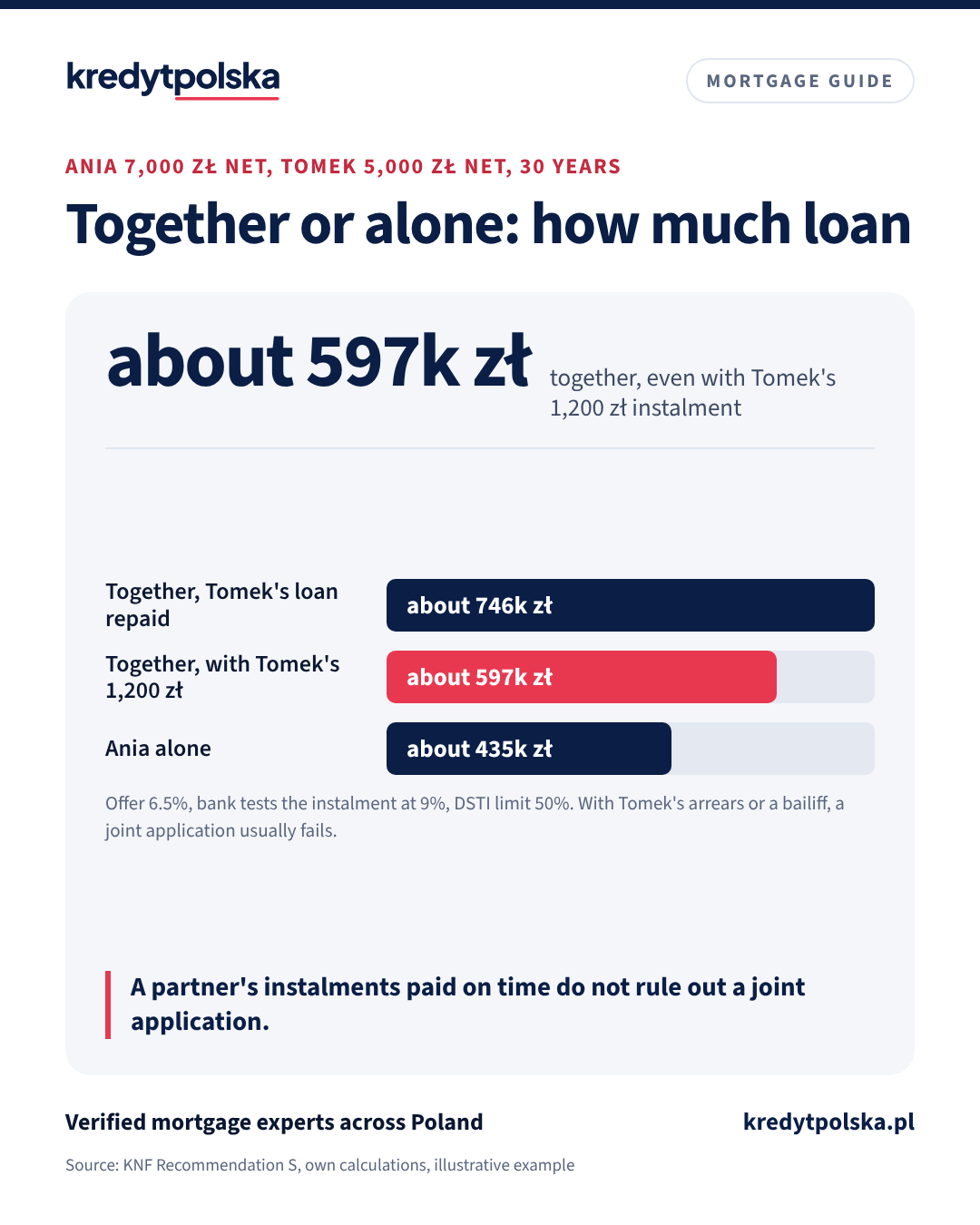
An illustrative example: Ania earns PLN 7,000 net, Tomek PLN 5,000 net and repays a cash loan of PLN 1,200 a month on time. 30-year loan, 6.5% offer, the bank tests the instalment at 9% with a 50% DSTI limit. Together, with Tomek’s instalment: about PLN 597,000. Together, after he repays it: about PLN 746,000. Ania alone: about PLN 435,000. If Tomek has arrears or a bailiff, the joint option usually drops out.
| Option | Income | Other instalments | Loan amount |
|---|---|---|---|
| Together, Tomek's loan repaid | 12,000 zł | 0 zł | about 746,000 zł |
| Together, with Tomek's instalment | 12,000 zł | 1,200 zł | about 597,000 zł |
| Ania alone | 7,000 zł | 0 zł | about 435,000 zł |
Unmarried couples
If you are not married, the bank assesses only the applicants. If you buy and borrow alone, your partner’s debts generally do not affect the decision and the flat belongs only to you, so your partner’s creditors cannot seize it. If you buy together, each of you owns a share, and a bailiff enforcing against your partner can seize their share (art. 1001 of the Polish Code of Civil Procedure).
Married couples
Under joint marital property, a debt your spouse took on with your consent can be recovered from joint property (art. 41 § 1 of the Family and Guardianship Code). A debt taken on without your consent, or before the marriage, can be recovered from your spouse’s personal property, salary and business income, not from all joint property (art. 41 § 2 and § 3). Two exceptions: spouses are jointly liable for debts for the ordinary needs of the family (art. 30), and a creditor with an enforceable title can ask the court to impose separate property (art. 52 § 1a) and then reach the debtor’s share. Buying a flat under joint property needs your spouse’s consent, and banks usually want both spouses on the loan.
What not to do
Do not hide debts from the bank: a false statement in a loan application is a criminal offence in Poland (art. 297 of the Criminal Code). Do not transfer property to your partner to hide it from creditors: they can challenge it in court (art. 527 of the Civil Code). A prenuptial agreement signed after the debt arose does not protect you against creditors who did not know about it.
The full description in Polish, with a table and a plan: Partner z długami: kredyt razem czy osobno.
Frequently asked questions
Can a partner with debts be a co-borrower?
Yes, if they repay their instalments on time. The bank deducts them but adds up your incomes. With current arrears, a BIG entry or a bailiff, a joint application is usually refused.
If we borrow together, am I liable for my partner’s other debts?
No. You are liable for the whole joint mortgage, but your partner’s other debts do not become yours. In a marriage the exceptions are debts taken on with your consent or for the ordinary needs of the family.
Can I get a mortgage alone if my unmarried partner has a bailiff?
Yes. The bank then assesses only you, and the flat belongs only to you, so your partner’s creditors cannot seize it.
Sources
- Family and Guardianship Code, art. 30, 41 and 52 (ISAP, Polish)
- Code of Civil Procedure, art. 1001 (ISAP, Polish)
- Polish Financial Supervision Authority (KNF): Recommendation S on mortgage lending
This guide describes general rules and typical bank practice as of October 2026. Details
It is not legal or tax advice and not a bank offer. Each bank sets its own criteria, and the lending decision is always made by the bank.
Read next
Mortgage calculator for Poland: your monthly instalment
Mortgage calculator for foreigners buying in Poland: equal or decreasing instalments in złoty, total interest, LTV, the bank stress test and a year-by-year schedule.
Arrears with ZUS or the tax office: can you still get a mortgage in Poland?
Can you get a mortgage in Poland with unpaid ZUS contributions or tax arrears? How instalment plans and deferrals affect the certificate of no arrears, compulsory mortgages and what to do before you apply.
Buying your municipal flat in Poland: discount, payment by instalments or a mortgage
How to buy a municipal flat from the gmina in Poland: the tenant's priority right, the discount set by the municipal council, instalments from the gmina for up to 10 years or a bank loan, and when the discount must be repaid after a sale within 5 years.
Unpaid leave and a mortgage in Poland: what changes for the bank?
How unpaid leave (urlop bezpłatny) affects a mortgage application in Poland, what to do between the loan decision and the payout, and how to keep up with instalments while your salary stops.
Student loan and a mortgage in Poland: how it lowers capacity and whether to repay it first
How a Polish student loan (kredyt studencki) affects your mortgage capacity, whether banks count it during the grace period, when it pays to repay it before applying and why to apply for loan forgiveness first.
Working in a family business in Poland: how banks treat a salary from a parent or spouse
How Polish banks assess a mortgage application when your employer is your parent or spouse, what the Polish social insurance rules on “cooperating persons” mean, and which documents help.
Bank statements and a mortgage in Poland: what the bank checks
What a Polish bank looks for on your account statements before a mortgage: betting, online games, transfers to family, instalments and BLIK. What is normal, what raises questions and how to prepare.