
In short
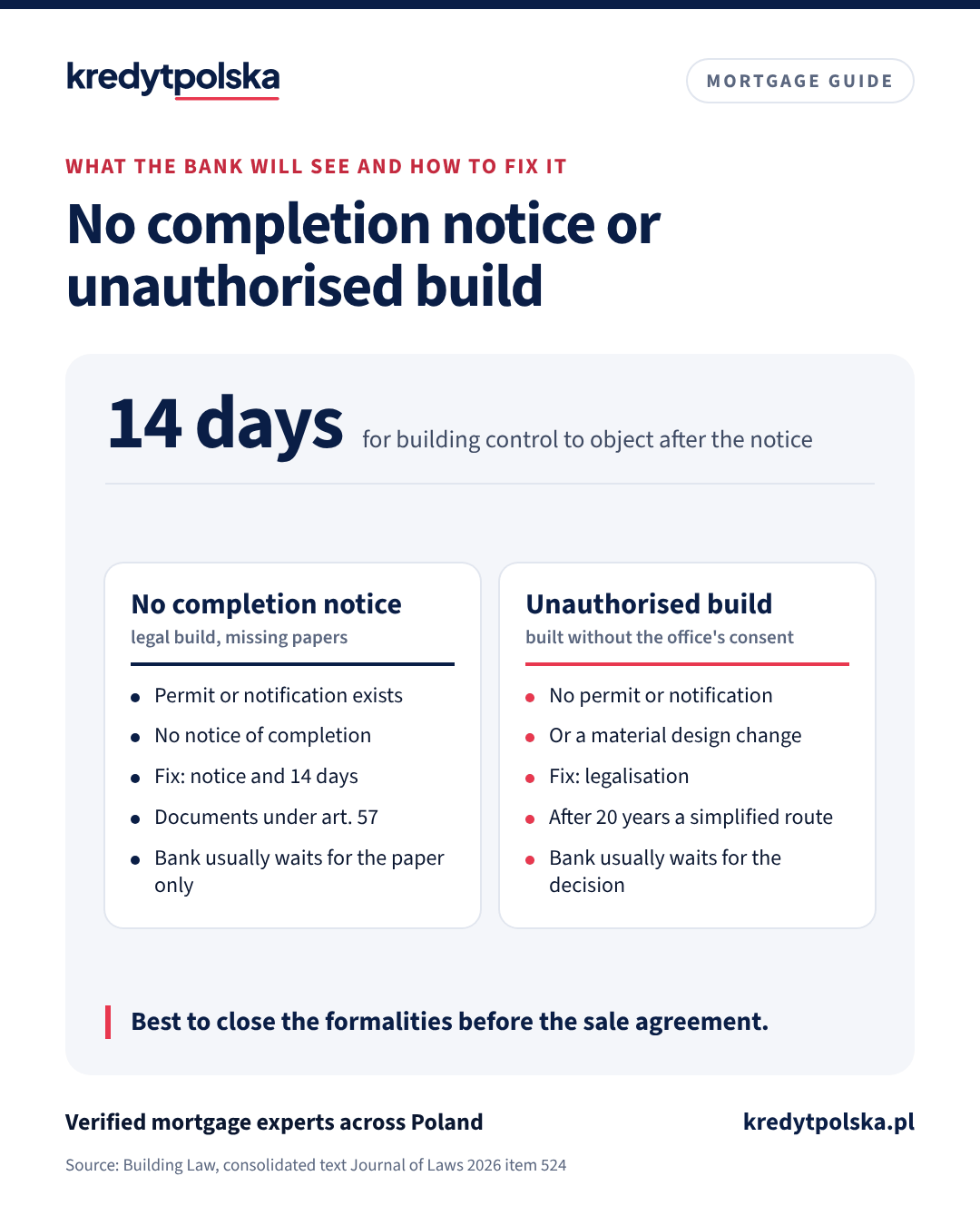
A house that is lived in without a completion notice is usually a paperwork issue, not a dead end. A Polish single-family house does not need an occupancy permit: the owner notifies the building inspectorate that construction is finished and waits 14 days. Unauthorised construction (samowola), built without a permit or notification, is harder: banks usually wait for a legalisation decision. Twenty years after completion a simplified procedure applies, with no legalisation fee. It is best sorted out before the sale.
House without a completion notice
Under Polish building law (art. 54) you can start using a single-family house after notifying the district building inspectorate (nadzór budowlany) that construction is finished, if it does not object within 14 days. A separate occupancy permit is not required for houses. A “house without acceptance” usually means the investor never filed this notice. The notice needs, among other things, the construction log (dziennik budowy), the site manager’s statement that the house matches the design, an as-built geodetic survey, installation test reports and an energy performance certificate (art. 57). It can be filed on paper or online in the e-Budownictwo portal.
Penalty for living there without the notice
The inspectorate first instructs the owner (art. 59i). Only if nothing changes within 60 days does it impose a penalty, usually 10,000 zł for a single-family house, followed by 5,000 zł penalties at least 30 days apart. If you complete the formalities after the instruction, there is no penalty.
| Step | When | Effect |
|---|---|---|
| Instruction | at the inspection | no penalty |
| Check | after 60 days | penalty 10,000 zł |
| Next check | after 30 days | penalty 5,000 zł |
Amounts for a single-family house: a 500 zł rate × the factors in the annex to the act (art. 59f).
Unauthorised construction and legalisation
Samowola means building without the required permit or notification, or with a major deviation from the design, such as a larger building or an extra storey. Typical cases are an extension, garage or converted attic without approval. Ordinary legalisation requires documents similar to a new building application and a legalisation fee of 50,000 zł for a house (art. 49d), and the house then needs an occupancy permit. If at least 20 years have passed since completion, a simplified procedure applies (art. 49f): a statement of the right to the property, an as-built survey and a technical expert opinion confirming the building is safe. There is no legalisation fee, and the decision itself allows the building to be used.
| Procedure | When | Fee |
|---|---|---|
| Standard legalisation | built within the last 20 years | house: 50,000 zł |
| Simplified legalisation | at least 20 years since completion | no fee |
Fee under art. 49d. For smaller structures built on a notification it is lower: 5,000 zł or 2,500 zł, depending on the type.
How banks look at it
The bank needs to know that the house can be legally used and sold. The valuer compares the building with its documents. For a house without a notice, banks usually ask for the notice with no objection from the inspectorate. For unauthorised construction, they usually wait for a final legalisation decision. For a construction loan, BOŚ Bank’s rules, for example, require the completion notice or occupancy permit within 4 months of the last tranche, otherwise the bank may raise the margin.
What to check before buying
Ask for the building permit or notification, the design and the construction log. Compare the house with the design, ideally with a site manager or inspector. Ask the seller to confirm in writing what was filed with the building inspectorate. Agree that the seller completes the formalities before the notarial deed, and write a deadline and a mortgage condition into the preliminary agreement. The land register does not show unauthorised construction, so these checks matter.
The full description in Polish, with a table of penalties and a step-by-step checklist: Samowola budowlana albo dom bez odbioru a kredyt.
Frequently asked questions
Can I get a mortgage on a house without a completion notice in Poland?
Often yes, if the construction was legal and only the completion notice is missing. Banks usually ask for the notice with no objection from the building inspectorate, so it is best to file it before the loan application.
Does a single-family house in Poland need an occupancy permit?
Usually not. A completion notice to the building inspectorate and 14 days without objection are enough. An occupancy permit is needed, among other cases, after ordinary legalisation of unauthorised construction.
How much does legalising unauthorised construction cost?
In the ordinary procedure the legalisation fee for a single-family house is 50,000 zł. After at least 20 years from completion the simplified procedure has no legalisation fee; you pay for the survey and the technical opinion.
Sources
- Construction Law, consolidated text Journal of Laws 2026 item 524, art. 49–49i, 54, 55, 57, 59f, 59i (Polish)
- BOŚ Bank: mortgage rules from 17 April 2026, points 120–121 (Polish)
- GUNB: e-Budownictwo portal (Polish)
This guide describes general rules and typical bank practice as of October 2026. Details
It is not legal or tax advice and not a bank offer. Each bank sets its own criteria, and the lending decision is always made by the bank.
Read next
Mortgage calculator for Poland: your monthly instalment
Mortgage calculator for foreigners buying in Poland: equal or decreasing instalments in złoty, total interest, LTV, the bank stress test and a year-by-year schedule.
House or plot without power, water or sewage in Poland: mortgage and construction tranches
Can you get a Polish mortgage for a plot or house without electricity, water or sewer connections: zoning conditions, septic tank, treatment plant or well, utility connections in the tranche schedule and the completion notice.
Buying an unfinished house from another person in Poland with a mortgage
How to buy a house under construction (stan surowy) from a private seller in Poland with a mortgage: tranches, valuation, transfer of the building permit, a build stopped for years and the seller’s loan.
Buying a house or plot in Poland: access road, road share and the mortgage
Why a Polish bank checks legal access to a public road before a mortgage on a house or plot, how a share in a private access road and a road easement work, and what to check before paying a deposit.
House extension mortgage in Poland: notification or permit, and what the bank needs
A Polish mortgage for extending a house or adding a storey: when a notification is enough and when you need a building permit, which documents the bank wants, and how tranches and the valuation after the works work.
Buying your municipal flat in Poland: discount, payment by instalments or a mortgage
How to buy a municipal flat from the gmina in Poland: the tenant's priority right, the discount set by the municipal council, instalments from the gmina for up to 10 years or a bank loan, and when the discount must be repaid after a sale within 5 years.
Mortgage when working part-time in Poland: will a bank lend and how much?
Can you get a Polish mortgage on a part-time job (pół etatu)? How banks count part-time pay, an example for full-time, 3/4 and half-time, reduced hours after parental leave and what raises the amount.