
In short
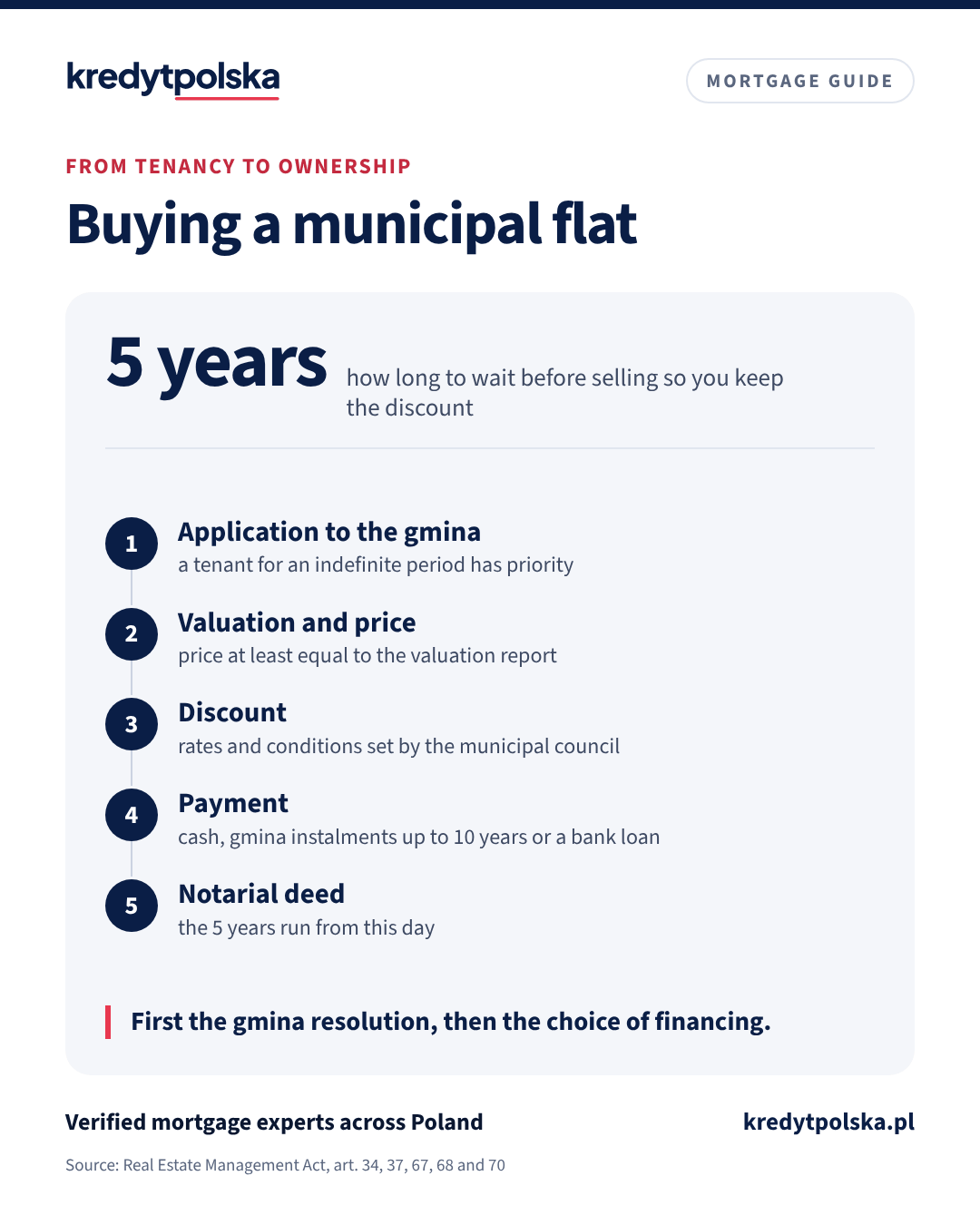
A tenant of a municipal flat with an open-ended tenancy has a priority right to buy it and buys without a tender (art. 34 and 37 of the Polish Real Estate Management Act). The municipality (gmina) may give a discount (bonifikata) on the price, and the municipal council sets its amount and conditions in a resolution. You can pay in cash, in instalments spread by the gmina over at most 10 years, or with a bank loan. If you sell the flat within 5 years of buying it, the gmina may demand repayment of the discount after indexation, unless within 12 months you use the money to buy another home or you sell to a close relative.
Who can buy a municipal flat
The tenant of a residential unit has a priority right to buy it if the tenancy was concluded for an indefinite period (art. 34(1)(3) of the Real Estate Management Act). The gmina then sells the flat without a tender (art. 37(2)(1)). When the gmina designates a building or unit for sale, it notifies the tenant in writing and sets a deadline for the application of at least 21 days from receiving the notice (art. 34(4)). The gmina is not obliged to sell every unit: it decides which flats it puts up for sale. Ask the city office or the municipal housing manager whether your building is on the sale list, which documents are needed and whether the resolution sets conditions, for example no rent arrears.
Price and discount
In a sale without a tender the price cannot be lower than the value of the property (art. 67(3)), set by a property valuer in a valuation report. The gmina may grant a discount when it sells the property as a residential unit (art. 68(1)(7)). The conditions and percentage rates are set by the municipal council in a resolution (art. 68(1b)), so discounts differ a lot between municipalities, and in many resolutions they also depend on whether you pay at once or in instalments. You will find the resolution in your gmina's Public Information Bulletin (BIP).
Instalments from the gmina or a bank loan
| How you pay | How it works | What to watch |
|---|---|---|
| Cash | full price before the notarial deed | discount as set in the resolution |
| Gmina instalments | up to 10 years, mortgage for the gmina | interest at the NBP rediscount rate |
| Bank loan | the bank pays the gmina | the bank's minimum loan amount |
Instalments and interest: art. 70(2) and (3) of the Real Estate Management Act. The council resolution sets the discount for each way of paying.
In a sale without a tender the gmina may spread the price over instalments for no longer than 10 years. You pay the first instalment no later than on the day of the notarial deed, and the rest is usually secured with a mortgage in favour of the gmina (art. 70(2)). The unpaid part bears interest at the National Bank of Poland rediscount rate (art. 70(3)). A bank loan is worth considering when the gmina does not offer instalments, when the discount for a one-off payment is clearly higher, or when you want to repay over more than 10 years. The bank treats the buyout like buying a flat on the secondary market: it orders a valuation, checks the land register and registers a mortgage. Thanks to the discount the loan is usually small compared with the value of the flat, so the LTV is favourable, but the price may be below the bank's minimum mortgage amount; then compare a mortgage-backed loan, a cash loan and instalments from the gmina. Mind the order: if part of the price stays in instalments, the gmina holds a mortgage on the flat, and a bank lending against the same flat usually wants first-ranking security, so you often have to repay the gmina first.
When the discount must be repaid
If you sell the flat or use it for a non-residential purpose within 5 years of acquiring it, the gmina may demand an amount equal to the discount after indexation (art. 68(2)). There is no repayment when you transfer the flat to a close relative, who then has the same restrictions until 5 years from your purchase; when you exchange it for another residential unit or property for housing; or when you sell it and within 12 months spend the money on another flat, a cooperative ownership right to a flat or property for housing (art. 68(2a)). If you spend only part of the money, you repay the discount for the part not used (art. 68(2d)). In other cases the gmina may waive the demand only with the council's consent (art. 68(2c)). The 5 years run from the day of the notarial deed, so keep the contracts and transfer confirmations.
The full description in Polish: Wykup mieszkania komunalnego na kredyt.
Frequently asked questions
Who can buy a municipal flat in Poland?
A tenant of a residential unit with a tenancy for an indefinite period. The tenant has a priority right and buys without a tender, but only when the gmina designates the flat for sale.
How big is the discount?
It depends on the gmina. The municipal council sets the conditions and percentage rates in a resolution, often different for payment at once and in instalments. Check the resolution in the gmina's Public Information Bulletin (BIP).
Can I buy a municipal flat with a mortgage?
Yes. The bank treats it like buying a flat on the secondary market and pays the price to the gmina. With a high discount the amount may be below the bank's minimum mortgage amount; then compare a mortgage-backed loan, a cash loan and instalments from the gmina.
When do I have to repay the discount?
When you sell the flat or use it for another purpose within 5 years of buying it. There is no repayment when you sell to a close relative, exchange it for another home, or within 12 months spend the money on another home.
Sources
- Real Estate Management Act of 21 August 1997, art. 34, 37, 67, 68 and 70, consolidated text Journal of Laws 2026 item 399 (Polish)
- NBP: basic interest rates, rediscount rate (Polish)
This guide describes general rules and typical bank practice as of October 2026. Details
It is not legal or tax advice and not a bank offer. Each bank sets its own criteria, and the lending decision is always made by the bank.
Read next
Mortgage calculator for Poland: your monthly instalment
Mortgage calculator for foreigners buying in Poland: equal or decreasing instalments in złoty, total interest, LTV, the bank stress test and a year-by-year schedule.
Mortgage for a flat in a listed building in Poland: the conservator, the bank valuation and the municipal pre-emption right
Buying a flat in a building on the Polish heritage register with a mortgage: register vs municipal list, what needs the conservator’s consent after June 2026, how banks value a listed building, the municipal pre-emption right and the PIT relief.
Buying a house in Poland without a completion notice or with unauthorised construction: will a bank lend?
How Polish banks treat a house that is lived in without a construction completion notice, or that has an unauthorised extension (samowola budowlana): how to finish the formalities, legalisation after 20 years, penalties and what to check before buying.
Buying a flat for your parents in Poland with a mortgage: who borrows and who owns
An adult child buys a flat for older parents in Poland: a mortgage in your name or theirs, free use or a right of residence, instalments as a gift and the SD-Z2 form, PCC and inheritance with siblings.
Inherited money as a down payment in Poland: documents and inheritance tax
Can you use cash from an inheritance as a down payment in Poland? The court decision or notarial certificate, the SD-Z2 form within 6 months, inheritance tax for other relatives and what Polish banks ask for.
Buying an unfinished house from another person in Poland with a mortgage
How to buy a house under construction (stan surowy) from a private seller in Poland with a mortgage: tranches, valuation, transfer of the building permit, a build stopped for years and the seller’s loan.
House extension mortgage in Poland: notification or permit, and what the bank needs
A Polish mortgage for extending a house or adding a storey: when a notification is enough and when you need a building permit, which documents the bank wants, and how tranches and the valuation after the works work.